
24.09.2026
Sustainable Compass Enters the Indian Market

18.09.2026
Strategic Agenda for IT Business Development Discussed in Astana
10.09.2026
GPI at China Conference: Central Asia 2026


In 1999, vegetation covered 32% of China’s Loess Plateau. By 2013, that figure had reached 59%. Similar changes were observed further north, where green cover increased from 5.05% to 13.84%, while dust storms became significantly less frequent — the average number of such days fell from 6.8 to 2.4 per year.
This work began back in 1978, when China launched the Three-North Shelterbelt Program, spanning the country’s northeast, north, and northwest — regions that had long suffered from advancing deserts, wind erosion, and soil loss. From the outset, the program was conceived as a multi-generational effort: it is scheduled to run from 1978 to 2050 and includes tree planting, grassland restoration, sand stabilization, and the protection of agricultural land.
Twenty years later, another major initiative began — Grain for Green. One of its key target areas was the Loess Plateau, where degraded slopes began to be restored through reforestation and grassland recovery. Over its first twenty years, the program covered around 34.3 million hectares across China.
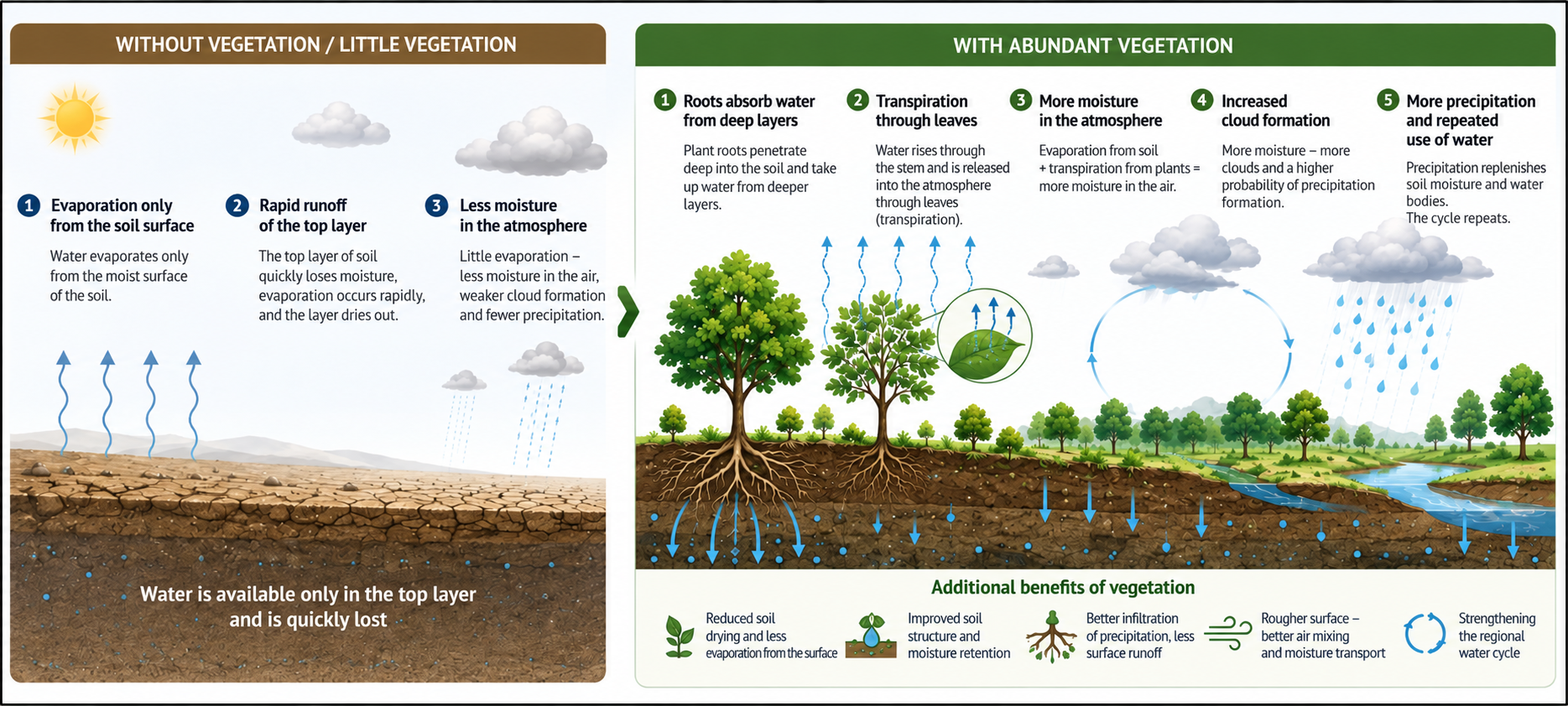
When greening extends across vast areas, it also alters the region’s water cycle. Plants draw moisture from the soil and return it to the atmosphere through transpiration, while water also evaporates from the soil surface and leaves, affecting air humidity, cloud formation, and precipitation. On the Loess Plateau, researchers recorded an increase in evapotranspiration of about 22.6 mm and an increase in precipitation during the rainy season of 54.6 mm, along with higher atmospheric moisture content, greater cloud formation, and more extensive recycling of water within the region.
Over time, changes on this scale became visible even from space. NASA satellites tracked Earth’s vegetation from 2000 to 2017 and recorded an increase of about 5% in the global leaf area. At least one quarter of that growth came from China.
Nearly half a century of work has shown that restoring large landscapes can reshape processes at the scale of an entire region — from land conditions to the movement of moisture in the atmosphere. In territories with dry climates, this approach requires decades, native plant species, and a precise understanding of the water balance. At the same time, its effects can shape the condition of the land for many years to come.

Wait for a call from our expert — we are already preparing the best solutions for you

Try submitting the application again. If the error appears again, please contact us directly: +7 717 225 84 84